
Game Theory, and economic principles, was revolutionized heavily by John Von Neumann in the early 20th century. Born in Budapest, Hungary in 1903, then János von Neumann was a child prodigy who specialized in mathematics. Having earned his doctorate in mathematics from the University of Budapest in 1926, he moved from the tumultuous regions of Europe to the United States in 1930, where he studied at Princeton.
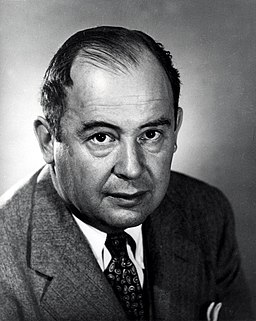
John Von Neumann’s work in mathematics introduced the concept of Game Theory through “The Theory of Parlor Games” in 1928, which focused on two-party zero-sum games. His work was expanded to include a focus on economic models in the 1930s, and the two concepts became tightly interwoven. Neumann’s work in mathematics spread across a litany of different disciplines, including fields like hydrodynamics, ballistics, and statistics. His academic rigor and brilliant mind allowed him to become a member of the Manhattan Project and near the end of World War II he was heavily engaged in consulting for governmental committees.
John Von Neumann’s work in mathematics made him the foremost mathematician of the 20th century, and he excelled in applying his mathematical approach to concepts well outside the pure mathematics he was comfortable with. One of his most prescient quotes given his range of experience is, “Can we survive technology?”
After writing well over 100 papers in mathematics and related disciplines, John Von Neumann died at the age of 53 on February 8, 1957. Following his death, his final work, published in 1958, titled “The Computer and the Brain” examined the similarities between computational machines and the human system. His collected works are still in publication today, and can be purchased online.
References
John von Neumann. (n.d.). Retrieved June 2, 2019, from https://www.econlib.org/library/Enc/bios/Neumann.html
John von Neumann: Life, Work, and Legacy. (n.d.). Retrieved June 2, 2019, from https://www.ias.edu/von-neumann
 Game Theory and Geopolitics