
Developing a global marketplace through infrastructure expansion became a key component of China’s geopolitical strategy in 2013, with the paired introduction of the Silk Road Economic Belt and the 21st Century Maritime Silk Road, which later combined to become the Belt and Road Initiative (BRI). This initiative plays a large role in understanding economic policy shifts in global perspectives, as it is the key component in China’s strategy in becoming the economic leader in not only the Asia region, but internationally as well. The strategy incorporates a wide array of infrastructure development projects, ranging from hard form infrastructure to digital development.

Developing a global marketplace through infrastructure expansion became a key component of China’s geopolitical strategy in 2013, with the paired introduction of the Silk Road Economic Belt and the 21st Century Maritime Silk Road, which later combined to become the Belt and Road Initiative (BRI). This initiative plays a large role in understanding economic policy shifts in global perspectives, as it is the key component in China’s strategy in becoming the economic leader in not only the Asia region, but internationally as well. The strategy incorporates a wide array of infrastructure development projects, ranging from hard form infrastructure to digital development.
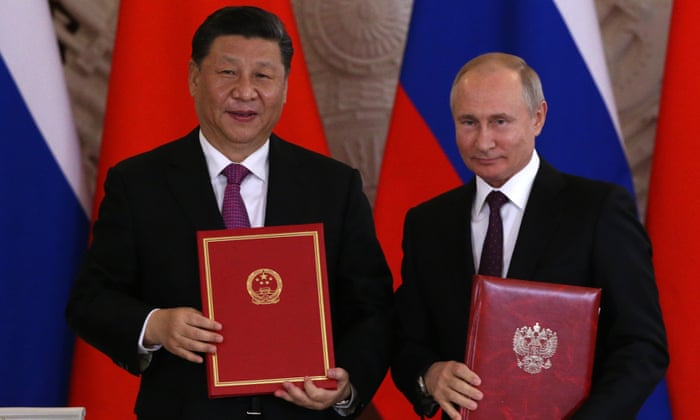
On June 6th, in Moscow, China and Russia held a summit in which the Chinese technology company Huawei signed a critical development deal with Russian telecommunications company MTS that would lead to the implementation of 5g networks across Russia. This network expansion operates as a key component of the Belt and Road Initiative’s reach into the Asia and Europe regions, as political complications internationally have threatened the long term financial health of Huawei given the recent ban on U.S. companies selling to Huawei due to fears of the company spying on behalf of Beijing. This ban in turn could lead to China taking chip manufacturing into their own hands through the ‘Made in China 2025’ initiative, which would spark international strife between China and the United States in the technology development market.
The geopolitical impact of this in regards to game theory is entirely based on the notion that China’s long term strategy is to play many non-zero sum games with international geopolitical partners, for the purpose of winning the zero sum game for global marketplace superiority against the United States. By approaching the long term conflict with longitudinal perspectives in mind, it allows China to garner compartmentalized support from current allies to the United States in the effort to extend influence across as wide of a spectrum as possible. With this support, it puts the United States in a precarious position of maintaining superiority in influence as economic and political relationships strain due to a sharp rise in increasingly protectionist approaches to foreign relations.
Given these factors, if the United States doesn’t approach the Belt and Road Initiative and China as a burgeoning economic superpower with cooperative tact and mindfulness of long-term relationships with allied countries, they will soon be relegated to a lower position on the global economic influence leader board, which in turn acts as a threat to the function of being able to effectively capitalize on the marketplace that has been established. The long term impacts of this include the United States becoming a lagging country in regards to indicators like global trade and the influence of alliances internationally.
References
Agencies. (2019, June 06). China’s Huawei signs deal to develop 5G network in Russia. Retrieved June 9, 2019, from https://www.theguardian.com/technology/2019/jun/06/chinas-huawei-signs-deal-to-develop-5g-network-in-russia
Chatzky, A., & McBride, J. (2019, May 21). China’s Massive Belt and Road Initiative. Retrieved June 9, 2019, from https://www.cfr.org/backgrounder/chinas-massive-belt-and-road-initiative
McBride, J., & Chatzky, A. (2019, May 13). Is ‘Made in China 2025’ a Threat to Global Trade? Retrieved June 9, 2019, from https://www.cfr.org/backgrounder/made-china-2025-threat-global-trade
 Game Theory and Geopolitics